

LESSONS
LESSON 4
Expanding the Framework to the Key of A
Lessons Overview → Lesson 1 → Lesson 2 → Lesson 3 → Lesson 4 → Lesson 5 → Lesson 6 → Lesson 7 → Lesson 8
This lesson is part of the Early Electric Blues Guitar Lesson Series.
For best results, complete all nine lessons in order. Each lesson builds directly on the previous one.
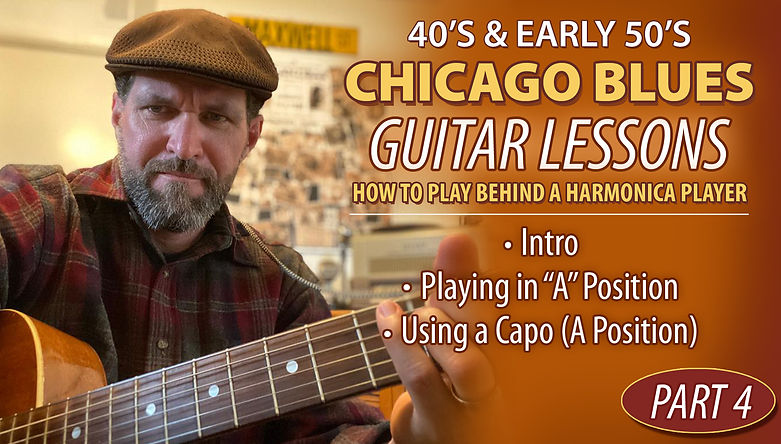
Lesson 4: Expanding the Framework to the Key of A
Expand the musical framework established in the previous lessons by applying the same principles to the key of A. Learn how the rhythmic vocabulary, accompaniment techniques, and musical ideas you've developed can be adapted to a new key while maintaining the relaxed groove, expressive feel, and authentic sound of Early Electric Blues (1937–1953).
27:40 • Opens on YouTube
OVERVIEW
Lesson 4 expands the rhythmic foundation established in the key of E into the key of A. The goal is not to learn an entirely different approach, but to understand how the same musical principles can be carried into a second position while preserving the steady bass, relaxed groove, dynamic control, and open-string weight developed throughout the earlier lessons.
By learning to work comfortably in both E and A, you begin building a practical accompaniment system that can be adapted to nearly any key while maintaining the understated, conversational feel that defines Early Electric Blues.
WHAT YOU'LL LEARN
You will learn how to establish a complete rhythm framework in the key of A using open strings, chord fragments, bass movement, and compact melodic figures.
The lesson begins by translating the foundational rhythm and boogie patterns into the A position. From there, you will develop barred 7th chords, high and low double stops, movement over the IV and V chords, 9th chord variations, turnarounds, and traditional song endings.
You will also learn how a capo can extend the A position into additional keys without losing the open-string bottom end that gives this style much of its weight and character.
By the end of the lesson, the key of A should no longer feel like a separate collection of shapes. It becomes a second fully functional accompaniment position that works together with the key of E.
LESSON CHAPTERS
For easier navigation, these timestamps are also included as clickable chapter links in the YouTube video description.
...
00:00 — Lesson 4 Demo
04:41 — 4.1 Introduction
06:30 — 4.2 Translating the Framework to the Key of A
08:47 — 4.3 Open Rhythm in A
09:57 — 4.4 Boogie Pattern in A
11:05 — 4.5 I–IV–V Demonstration
14:17 — 4.6 Adding the 3rd
15:12 — 4.7 Barred 7ths
15:19 — 4.8 Double Stops (High)
16:16 — 4.9 Double Stops (Low)
17:35 — 4.10 IV Variations
18:14 — 4.11 V Chord
21:25 — 4.12 9ths
22:55 — 4.13 Turnarounds
24:13 — 4.14 Song Endings
25:42 — 4.15 Capo in A
27:11 — 4.16 Using a Capo to Play in All Keys
...
KEY TAKEAWAYS
The key of A should feel like an extension of the framework developed in the key of E rather than an entirely separate system.
The most important objective is consistency. The groove should remain steady, the bass should continue carrying responsibility, and the accompaniment should support the song without becoming crowded or overly decorative.
Learning both the E and A positions provides access to nearly every practical key while preserving the open-string resonance and bottom-end movement that are central to this music.
The capo is more than a convenience. Used thoughtfully, it allows you to preserve familiar phrasing, touch, and rhythmic structure while adapting the same accompaniment language to different vocal ranges and musical settings.
CONTINUE THE SERIES
Lesson 5 begins connecting the E and A positions into a more complete musical vocabulary. Rather than thinking of them as separate accompaniment patterns, you'll begin moving naturally between positions while incorporating additional rhythm variations, melodic movement, and practical song applications.
As the framework expands, the focus shifts from learning individual techniques to developing the confidence to support an entire performance with relaxed timing, dynamic control, and tasteful movement.
Questions?
If something in this lesson isn't clear, feel free to leave a comment on YouTube or reach out through the contact page.
Next Lesson → Lesson 5
Hear These Ideas in Context
Many of the techniques covered throughout the lesson series can be heard on my recordings.
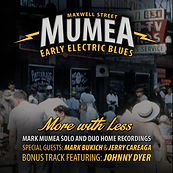


Explore recordings available through Devil's Tale Music.
For over two decades I've independently released recordings dedicated to preserving and celebrating traditional blues through Devil's Tale Music.