

LESSONS
LESSON 1
Building the Foundation
Lessons Overview → Lesson 1 → Lesson 2 → Lesson 3 → Lesson 4 → Lesson 5 → Lesson 6 → Lesson 7 → Lesson 8
This lesson is part of the Early Electric Blues Guitar Lesson Series.
For best results, complete all nine lessons in order. Each lesson builds directly on the previous one.

Lesson 1: Building the Foundation
Establish the essential rhythm, accompaniment, and musical vocabulary that form the foundation of the Early Electric Blues Guitar Lesson Series. By mastering these core principles first, each lesson that follows builds naturally toward a deeper understanding of the style, feel, and sound of Early Electric Blues (1937–1953).
19:48 • Opens on YouTube
OVERVIEW
Lesson 1 establishes the rhythmic foundation that the rest of the Early Electric Blues Guitar Lesson Series is built upon. Rather than beginning with lead guitar, you'll learn the core rhythm patterns, bass concepts, and sense of time that defined early electric blues accompaniment.
The lesson focuses on economy and function—learning a small vocabulary of patterns that can be applied across different tempos, grooves, and harmonic situations without overplaying. These are the kinds of parts early Chicago and Detroit blues guitarists relied on night after night while supporting vocals and harmonica.
Beginning with two-string rhythm patterns, the lesson gradually expands into boogie figures, Detroit-style grooves, and multiple single-note bass line approaches inspired by classic recordings.
Although this lesson was recorded before the later lessons were fully formalized, it establishes the core vocabulary that everything else in the series builds upon. Lessons 2 and 3 expand directly from this foundation.
WHAT YOU'LL LEARN
You'll learn how to build a steady rhythmic foundation using two-string rhythm patterns, traditional boogie figures, Detroit-style accompaniment, and several single-note bass line approaches. Throughout the lesson, the emphasis remains on developing strong time, economical movement, and functional accompaniment that supports the song rather than competing with it.
LESSON CHAPTERS
For easier navigation, these timestamps are also included as clickable chapter links in the YouTube video description.
...
INTRODUCTION
00:00 — Lesson Demo
02:02 — Introduction & Explanation
FOUNDATION
04:04 — Pattern 1 – Two-String Rhythm over the I
05:16 — Pattern 1 – Two-String Rhythm over the IV
06:10 — Palm Muting Technique
07:34 — Complete Pattern 1 Demo
BOOGIE PATTERNS
08:04 — Pattern 2 – Boogie Pattern over the I
08:31 — Pattern 2 – Boogie Pattern over the IV
08:43 — Pattern 2 – Boogie Pattern over the V
08:52 — Complete Pattern 2 Demo (I, IV, V)
09:22 — Pattern 3 – Boogie Extension over the I
10:13 — Pattern 3 – Boogie Extension over the IV
10:24 — Pattern 3 – Boogie Extension over the V
10:37 — Patterns 1–3 Recap & Demo (I, IV, V)
DETROIT STYLE
11:13 — Pattern 4 – Detroit Boogie Pattern
SINGLE-NOTE BASS LINES
11:58 — Pattern 5 – Single-Note Bass Line
12:39 — Pattern 6 – Single-Note Boogie Bass Line
13:35 — Pattern 6 Demo over I, IV, V
14:07 — Pattern 7 – Single-Note Slow Bass Line (Sad Hours – Little Walter)
14:49 — Pattern 8 – Single-Note Slow Bass Line #2 (Blue Midnight – Little Walter)
15:43 — Pattern 9 – Joe Willie Wilkins-Style Bass Line (Behind Big Boy Crudup's "Make a Little Love" harmonica solo)
PHILOSOPHY
16:26 — Economy of Movement – Using the Same Patterns Across Tempos & Grooves
17:12 — Closing Thoughts – Listening, Practice & Philosophy
...
KEY TAKEAWAYS
The strongest rhythm guitar begins with a small vocabulary used exceptionally well. Rather than constantly searching for new ideas, learn to apply the same patterns across different tempos, grooves, and harmonic situations.
Economy of movement allows your playing to remain relaxed, supportive, and musical. These foundational rhythm and bass concepts become the building blocks for everything introduced throughout the remainder of the lesson series.
Above all, develop steady time, listen carefully to the original recordings, and allow the music itself to shape your approach.
CONTINUE THE SERIES
Lesson 2 builds on the rhythmic foundation established here by introducing the first melodic and harmonic elements of early electric blues accompaniment. You'll learn how to blend melody, rhythm, and bass into a single musical voice using hammered thirds, dominant chord shapes, walking transitions, double stops, and traditional turnarounds. Together, these ideas begin transforming simple rhythm guitar into the complete accompaniment style heard throughout the early electric blues era.
Questions?
If something in this lesson isn't clear, feel free to leave a comment on YouTube or reach out through the contact page.
Next Lesson → Lesson 2
Hear These Ideas in Context
Many of the techniques covered throughout the lesson series can be heard on my recordings.
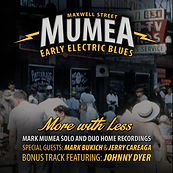


Explore recordings available through Devil's Tale Music.
For over two decades I've independently released recordings dedicated to preserving and celebrating traditional blues through Devil's Tale Music.