

LESSONS
LESSONS 1–8
EARLY ELECTRIC BLUES GUITAR
Introduction → Lesson 1 → Lesson 2 → Lesson 3 → Lesson 4 → Lesson 5 → Lesson 6 → Lesson 7 → Lesson 8
This lesson is part of the Early Electric Blues Guitar Lesson Series.
For best results, complete all nine lessons in order. Each lesson builds directly on the previous one.
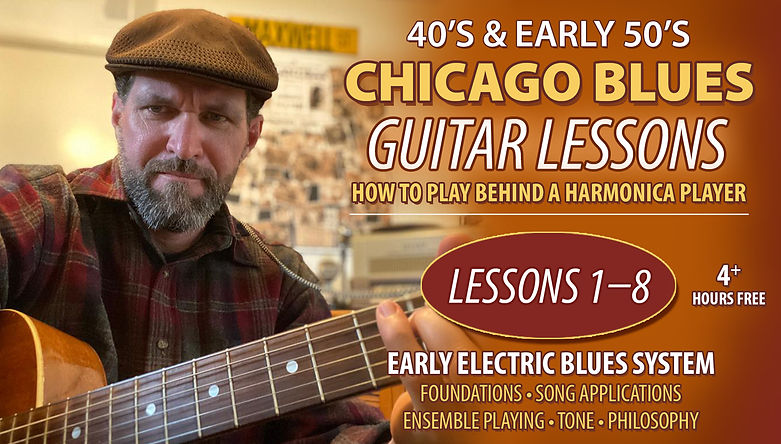
Complete Course: Lessons 1–8
Follow the complete progression of the Early Electric Blues Guitar Lesson Series, from the fundamental building blocks of rhythm and accompaniment to expressive lead playing, tone, dynamics, and musical conversation. Spanning more than four hours of structured instruction across eight core lessons, this course is designed to help you develop an authentic understanding of the techniques, feel, and musical language that shaped Early Electric Blues between 1937 and 1953.
4:34:49 • Opens on YouTube
OVERVIEW
This complete course contains more than four hours of free instruction covering the guitar techniques, musical language, and performance practices of Early Electric Blues (1937–1953).
Rather than approaching the style through isolated licks or solos, the course builds from the ground up, beginning with rhythm, timing, accompaniment, and ensemble playing before gradually expanding into lead guitar, complete song studies, tone production, and musical expression. Every lesson builds directly upon the concepts introduced in the previous one, creating a structured system designed to develop a complete understanding of the style.
The material is inspired by the recordings of Robert Lockwood Jr., Muddy Waters, Little Walter, Jimmy Rogers, Floyd Jones, Johnny Shines, Baby Face Leroy Foster, Moody Jones, John Lee Williamson, Snooky Pryor, and many of the musicians who shaped the development of Early Electric Blues between 1937 and 1953.
As I often say throughout the course:
"Most players try to start this style from the top—licks, solos, ideas. This music was built from the bottom up."
That philosophy forms the foundation of everything you'll learn throughout these eight lessons.
WHAT YOU'LL LEARN
The series begins by establishing the rhythmic vocabulary that defines Early Electric Blues. Lessons 1 through 3 focus on rhythm guitar, bass movement, accompaniment, chord vocabulary, turnarounds, double-stops, and the subtle techniques that create a relaxed, supportive groove.
Lesson 4 expands these concepts into the key of A, demonstrating how the same musical language can be applied across different keys while introducing additional accompaniment techniques, endings, and capo strategies.
Lesson 5 introduces lead guitar, showing how expressive solos grow naturally from chord tones, rhythm playing, and musical conversation rather than scale patterns alone. You'll also learn to apply these ideas confidently in multiple keys.
Lessons 6 and 7 move beyond individual techniques and demonstrate how everything comes together inside complete performances. Through detailed studies of "Shake Dancer" and "That's All Right," you'll learn how introductions, accompaniment, fills, transitions, and solos function together to support a complete song.
The course concludes with Lesson 8, exploring the finer points of tone, right-hand technique, dynamics, musical expression, equipment, ensemble playing, and the philosophy that ties the entire system together.
LESSON CHAPTERS
...
L1 – E
00:00 – 1.0 Lesson Demonstration
02:02 – 1.1 Introduction
04:04 – 1.2 Pattern 1
05:16 – 1.3 Pattern 1 (IV Chord)
06:10 – 1.4 Palm Muting
07:34 – 1.5 Pattern 1 Demonstration
08:04 – 1.6 Pattern 2
08:31 – 1.7 Pattern 2 (IV Chord)
08:43 – 1.8 Pattern 2 (V Chord)
08:52 – 1.9 Pattern 2 Demonstration
09:22 – 1.10 Pattern 3
10:13 – 1.11 Pattern 3 (IV Chord)
10:24 – 1.12 Pattern 3 (V Chord)
10:37 – 1.13 Pattern Demonstration
11:13 – 1.14 Detroit Boogie
11:58 – 1.15 Single-Note Bass
12:39 – 1.16 Boogie Bass
13:35 – 1.17 Bass Demonstration
14:07 – 1.18 Slow Bass
14:49 – 1.19 Slow Bass #2
15:43 – 1.20 Wilkins Bass
16:26 – 1.21 Economy of Movement
17:12 – 1.22 Closing
L2 – E
19:46 – 2.0 Overview
21:15 – 2.1 Transition from Lesson 1
22:13 – 2.2 Open High E String
23:32 – 2.3 Hammered 3rd
24:00 – 2.4 Building a Lick
25:05 – 2.5 Flattened Chords
26:01 – 2.6 Dominant 7th Chords
26:53 – 2.7 Long A (IV Chord)
27:19 – 2.8 Walking to the IV Chord
27:48 – 2.9 Walking to the V Chord
28:13 – 2.10 Double Stops
29:14 – 2.11 Combining the Ideas
29:45 – 2.12 V Chord with 7th & 9th
30:43 – 2.13 Movable Long A
31:34 – 2.14 Turnarounds
32:35 – 2.15 Lockwood Lick
33:50 – 2.16 Resolving with the 7th
34:18 – 2.17 Closing
L3 – E
34:33 – 3.0 Overview
37:33 – 3.1 Introduction
39:50 – 3.2 Sliding 9ths
41:26 – 3.3 Chord Shapes
43:07 – 3.4 7th Variations
43:47 – 3.5 Big 9th Chord
44:33 – 3.6 Flattened Chord Comping
46:10 – 3.7 Flattened Chord Variations
46:46 – 3.8 Double Stops
48:12 – 3.9 Extended Runs
49:33 – 3.10 Tougher Feel
50:02 – 3.11 Summary
52:30 – 3.12 Fretboard Layout
54:07 – 3.13 Lockwood Lick
55:05 – 3.14 Shuffle Pattern
56:43 – 3.15 Using a Capo
58:54 – 3.16 Closing
L4 – A
1:00:11 – 4.0 Lesson Demonstration
1:04:52 – 4.1 Open Rhythm
1:06:41 – 4.2 Boogie Pattern
1:08:58 – 4.3 I–IV–V Demonstration
1:10:08 – 4.4 Adding the 3rd
1:11:16 – 4.5 Barred 7th Chords
1:14:28 – 4.6 High Double Stops
1:15:23 – 4.7 Low Double Stops
1:15:30 – 4.8 Walk-Up
1:16:27 – 4.9 IV Chord Variations
1:17:46 – 4.10 V Chord
1:18:25 – 4.11 9th Chords
1:21:36 – 4.12 Turnarounds
1:23:06 – 4.13 Endings
1:24:24 – 4.14 Using a Capo in A
1:25:53 – 4.15 Using a Capo in Every Key
L5 – LEAD
1:27:16 – 5.0 Overview
1:28:33 – 5.1 Philosophy
1:30:30 – 5.2 Chord Notes
1:32:48 – 5.3 A Run
1:34:28 – 5.4 Pattern #2
1:36:52 – 5.5 Ascending
1:38:24 – 5.6 Descending
1:39:22 – 5.7 Lick Part 1
1:40:55 – 5.8 Lick Part 2
1:43:26 – 5.9 Complete Lick
1:45:10 – 5.10 Musical Influences
1:46:49 – 5.11 Guitars
1:47:59 – 5.12 Slides & Hammer-Ons
1:49:57 – 5.13 Micro Bends
1:51:15 – 5.14 Building an Introduction
1:52:46 – 5.15 Vibrato
1:55:32 – 5.16 Chord Stabs
1:57:48 – 5.17 9th Chords
1:59:35 – 5.18 Positions 1 & 2
2:01:14 – 5.19 Position 3
2:02:58 – 5.20 Position 4
2:04:39 – 5.21 Position 5
2:05:22 – 5.22 Demonstration
2:08:41 – 5.23 Time & Feel
2:10:40 – 5.24 Applying the System: A to E
2:13:33 – 5.25 Key of F
2:14:47 – 5.26 Key of G
2:15:35 – 5.27 Key of B♭
2:16:38 – 5.28 Key of B
2:17:25 – 5.29 Key of C
2:18:22 – 5.30 Key of D
2:19:27 – 5.31 Picking Technique
2:21:46 – 5.32 Conclusion
L6 – SHAKE DANCER
2:23:56 – 6.0 Lesson Demonstration & Introduction
2:27:50 – 6.1 First 12 Bars
2:29:42 – 6.2 Turnaround
2:30:35 – 6.3 Descending Double Stops
2:31:34 – 6.4 First 12 Bars Demonstration
2:32:15 – 6.5 Second 12 Bars (Part 1)
2:33:14 – 6.6 Second 12 Bars (Part 2)
2:35:06 – 6.7 Third 12 Bars
2:36:24 – 6.8 Third 12 Bars Demonstration
2:36:55 – 6.9 Fourth 12 Bars (Part 1)
2:38:00 – 6.10 Fourth 12 Bars (Part 2)
2:39:14 – 6.11 Fifth Chorus
2:39:43 – 6.12 Sixth Chorus
2:41:12 – 6.13 Sixth Chorus Demonstration
2:41:40 – 6.14 Ending
L7 – THAT'S ALL RIGHT
2:43:09 – 7.0 Lesson Demonstration
2:43:33 – 7.1 Origins
2:45:41 – 7.2 Opening Double Stops
2:47:34 – 7.3 IV Chord
2:49:47 – 7.4 V Chord
2:51:07 – 7.5 Intro Turnaround
2:53:21 – 7.6 Intro Recap
2:53:48 – 7.7 Adding Bass
2:56:17 – 7.8 Backing the Vocal
2:59:49 – 7.9 V Chord Phrasing
3:01:30 – 7.10 Guitar Solo (Part 1)
3:03:47 – 7.11 Guitar Solo (Part 2)
3:06:26 – 7.12 Solo Recap
3:08:20 – 7.13 The Chicago Sound
3:10:30 – 7.14 Early Recordings
3:12:59 – 7.15 Ora Nelle Records
3:15:57 – 7.16 Intro Comparison
3:18:10 – 7.17 Othum Brown
3:20:36 – 7.18 Robert Lockwood Jr.
L8 – TONE & TECHNIQUE
3:26:04 – 8.0 What Is Tone?
3:29:36 – 8.1 Early Electric Setup (Archtops & DeArmond Pickups)
3:32:54 – 8.2 Small Amps
3:43:42 – 8.3 Philosophy
3:47:39 – 8.4 Two Approaches
3:49:35 – 8.5 Acoustic Foundation
3:53:13 – 8.6 Dynamics
3:56:20 – 8.7 Amp Settings
4:02:43 – 8.8 Dynamic Range
4:06:11 – 8.9 Right-Hand Technique
4:10:28 – 8.10 Tone Shaping
4:18:07 – 8.11 Thumb & Fingers
4:24:29 – 8.12 Upstrokes vs. Downstrokes
4:29:18 – 8.13 Time & Voice
...
KEY TAKEAWAYS
Early Electric Blues is not built on technical complexity. It is built on timing, touch, dynamics, repetition, restraint, and the ability to support the song.
Throughout this course, you'll develop a complete musical framework rather than simply collecting individual ideas. By understanding how rhythm, accompaniment, lead guitar, tone, and ensemble playing relate to one another, you'll be better equipped to interpret the original recordings and develop your own authentic voice within the tradition.
The goal has never been to copy the masters note for note. The goal is to understand why they played the way they did and to apply those principles in your own playing.
CONTINUE THE JOURNEY
Completing this course is only the beginning.
The next step is to spend time with the original recordings. Listen carefully, play along with the pioneers of Early Electric Blues, and allow these ideas to become part of your own musical vocabulary.
As you revisit the lessons over time, you'll continue discovering new details and connections. My hope is that this course becomes a long-term reference you can return to throughout your musical journey.
Questions?
If you have questions while working through the course, feel free to leave a comment on any of the YouTube lessons. I do my best to answer every question and help students continue progressing through the material.
Thank you for investing your time in preserving and learning this remarkable tradition of American music.
Hear These Ideas in Context
Many of the techniques covered throughout the lesson series can be heard on my recordings.


Explore recordings available through Devil's Tale Music.
For over two decades I've independently released recordings dedicated to preserving and celebrating traditional blues through Devil's Tale Music.